Check out our White Paper Series!
A complete library of helpful advice and survival guides for every aspect of system monitoring and control.
1-800-693-0351
Have a specific question? Ask our team of expert engineers and get a specific answer!
Sign up for the next DPS Factory Training!
Whether you're new to our equipment or you've used it for years, DPS factory training is the best way to get more from your monitoring.
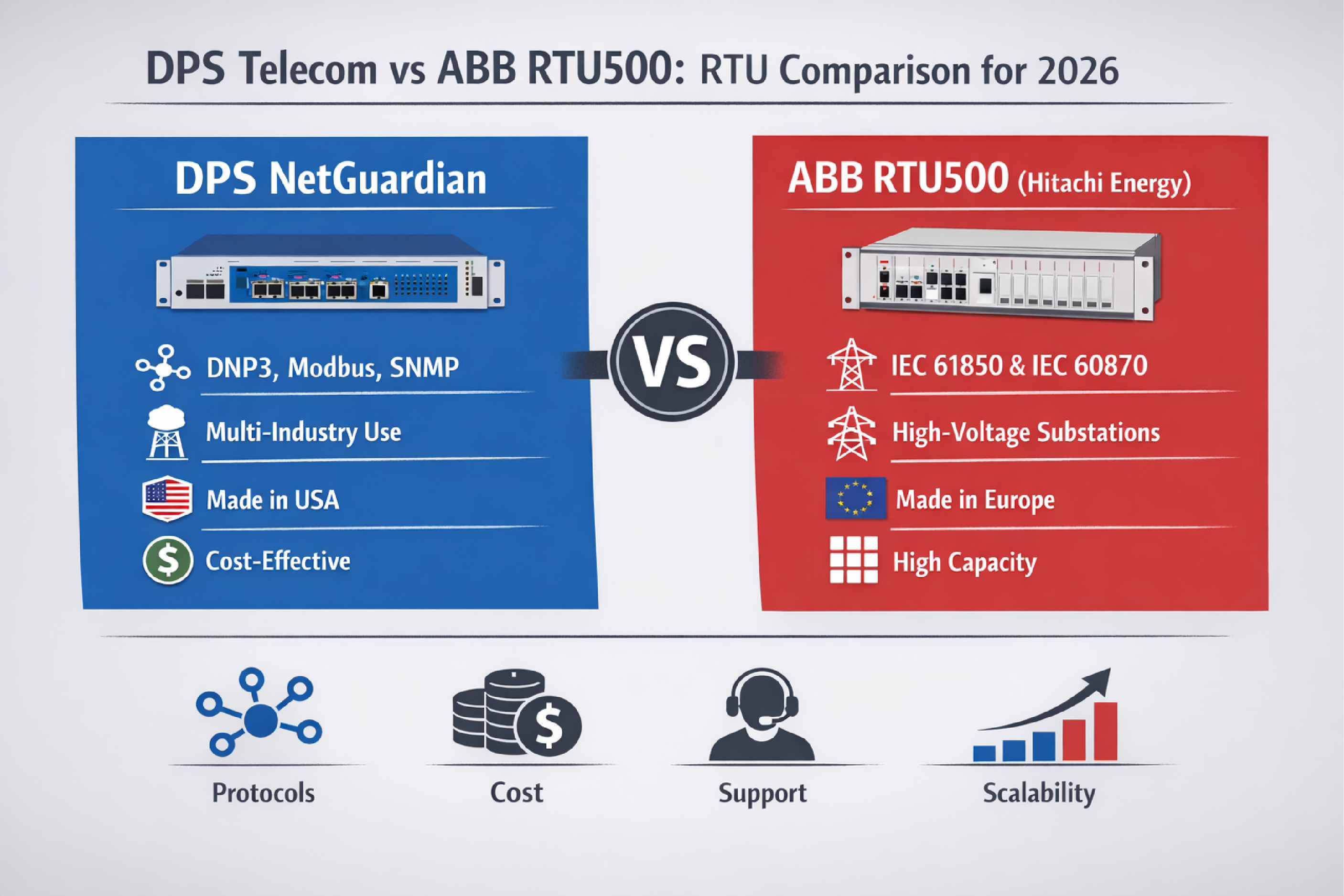
Reserve Your Seat TodayThe ABB RTU500 (now sold under Hitachi Energy) is designed for high-voltage transmission substations that require IEC 61850 protocol. DPS NetGuardian RTUs serve distribution networks, water systems, pipelines, and telecom sites using DNP3, Modbus, and SNMP protocols.
At DPS Telecom, we've deployed 172,000+ NetGuardian units across 500+ organizations over 37 years. This comparison examines hardware specifications, protocol support, total cost of ownership, and operational differences to help you evaluate which platform matches your monitoring requirements.
Before comparing specifications, it helps to understand where each platform came from and what problems each was designed to solve.
The RTU500 series was developed in Mannheim, Germany, for European power utility substations. ABB built it around IEC 61850 and IEC 60870 protocols, which are the standard communication methods in high-voltage transmission and substation automation.
The line includes three main models:
In 2020, Hitachi acquired ABB's Power Grids division. These products are now officially Hitachi Energy offerings, though you'll still see "ABB RTU500" in technical documentation and industry discussions.
Our NetGuardian product line started in telecom remote monitoring in the 1980s. We worked with rural telephone companies and wireless carriers who needed visibility into remote cell sites and central offices.
Over time, we expanded into other industries with similar needs. Electric utilities monitor distribution networks. Water districts track pump stations. Pipeline operators watch valve sites. Government agencies monitor critical facilities.
What these applications have in common is the need to monitor equipment from multiple manufacturers using different protocols. A typical site might have Modbus PLCs, SNMP network gear, DNP3 substation equipment, and proprietary building automation systems all in one location.
We built our platform around multi-protocol support. NetGuardian RTUs handle SNMP, DNP3, Modbus, and TL1 natively. Through our T/Mon master station, we can work with 25+ additional protocols, including proprietary formats.
Here's how the platforms compare on core specifications:
| Feature | ABB RTU560 | ABB RTU530 | NetGuardian 832A G5 | NetGuardian 864A G5 |
|---|---|---|---|---|
| Discrete inputs | 16 per module | 8 built-in | 32 (expandable to 176) | 64 (expandable to 256) |
| Serial ports | 2-6 (depends on communication module) | 2 (RS-232 + RS-485) | 8 RS-232 + 1 RS-485 | 8-16 RS-232 + 1 RS-485 |
| Ethernet | 2 ports per module | 2 ports | Dual NIC + optional 4-port switch | Dual NIC |
| Fiber optic | SFP module add-on | Not standard | Built-in dual SFP (ranges from 550m to 180km) | Optional |
| Cellular | Not standard | Not standard | Optional GSM/CDMA/LTE | Not standard |
| Dial-up modem | Not standard | Not available | Built-in 33.6K | Available as option |
| Temperature range | -25°C to +70°C | -25°C to +70°C | 0°C to +60°C (extended: -30°C to +70°C) | 0°C to +60°C |
| Mounting | 19" rack | DIN rail (35mm) | 19" or 23" rack, or wall mount | 19" or 23" rack |
| Power input | 24-60VDC or 110-220VDC | 24VDC (±20%) | Dual-feed -48VDC (options: ±12V, ±24V, +48V) | Dual-feed -48VDC |
If you're monitoring a single large substation with thousands of data points, the RTU560's modular rack architecture can efficiently handle very high I/O counts. You can add I/O modules as your monitoring needs grow.
Our NetGuardian 832A G5 includes features that would typically require separate equipment. It has 8 serial terminal server ports, fiber optic connectivity (up to 180km), optional cellular, and dial-up backup.
Here's why that matters in practice. When a site loses its primary Ethernet connection, you need a backup path to maintain visibility. With built-in cellular and dial-up options, you don't need to install separate console servers or out-of-band management equipment.
The 8 serial ports also let you connect equipment directly to the RTU. For example, a water utility client uses these ports to poll Modbus RTU flow meters that predate Ethernet connectivity. The RTU collects the data and forwards it to their SCADA system over IP.
Protocol compatibility is often the deciding factor in RTU selection. Here's the breakdown:
| Protocol Type | ABB RTU500 | NetGuardian RTUs | T/Mon Master |
|---|---|---|---|
| IEC 61850 (substation automation) | ✔ Client + Server | ✘ | ✘ |
| IEC 60870-5-101/104 (power utilities) | ✔ | ✘ | ✘ |
| DNP3 (utilities, SCADA) | ✔ | ✔ | ✔ |
| Modbus RTU/TCP | ✔ | ✔ | ✔ |
| SNMP v1/v2c/v3 (network gear, UPS) | v2c/v3 only | All versions | All versions |
| TL1 (telecom) | ✘ | ✔ | ✔ |
| Proprietary protocols | ✘ | ✘ | ✔ (25+ types) |
If you're implementing substation automation where IEC 61850 is mandated by engineering standards or utility requirements, the ABB RTU500 is designed specifically for that environment. It includes full IEC 61850 Edition 2 functionality. It supports IEC 60870-5-101/104. It integrates with substation automation systems that expect these protocols.
Most of the sites we monitor don't use IEC 61850. They use a mix of protocols:
Our NetGuardian RTUs handle all of these natively. We also support SNMP v1, which many facilities still use on equipment that predates later SNMP versions.
Organizations often ask about monitoring equipment that's 15-20 years old, manufactured by companies that may no longer actively support that product line. This is a common scenario across all types of infrastructure.
For example: Southern Company operates a large electric utility in the southeastern United States. They had hundreds of Badger 1200 RTUs deployed across their network. When Badger Systems ceased operations, they faced a choice between replacing everything or finding a way to continue using proven equipment.
Our engineering team developed a custom Larse Interrogator module for the T/Mon platform that could communicate with their Badger units. The project took about 3 months from initial contact to field deployment. Southern Company estimated this approach saved "hundreds of thousands of dollars" compared to immediate replacement.
When you're planning a deployment that might last 15-20 years, purchase price is only part of the equation. Here are the cost factors that often surprise people.
ABB RTU500: The RTU500 series uses RTUtil500, a Windows-based engineering tool for configuration and management. This software is purchased through Hitachi Energy sales channels with licenses tiered by features and capacity.
RTUtil500 includes IEC 61131-3 PLC programming capabilities through Multiprog PRO. This can be valuable for organizations implementing complex automation scenarios. Organizations upgrading hardware may want to consult with Hitachi Energy regarding licensing compatibility between different communication unit models.
DPS NetGuardian: Our RTUs are configured through a built-in web interface. No separate software is required. There are no license fees. Firmware upgrades are free for the life of the product.
For organizations managing dozens or hundreds of RTUs, this can affect ongoing costs as the monitoring network grows.
ABB RTUtil500: RTUtil500's IEC 61131-3 programming environment is well-suited for organizations implementing complex automation scenarios. Organizations using advanced functions like structured text programming or function block diagrams may benefit from formal training.
DPS NetGuardian: Our web interface is designed to minimize the learning curve. When clients get stuck, our support team includes product engineers. They can walk you through configuration over the phone or via screen share.
That said, we're realistic about complexity. If you're setting up protocol mediation through T/Mon for multiple equipment types, there's still a learning process. The difference is you're working with our engineering team rather than navigating documentation alone.
ABB/Hitachi Energy: ABB provides 24/7 global support through their Customer Connect Center. Their RTU Technical Support team is based in Mannheim, Germany. They serve over 100,000 RTUs across 2,000 clients in 100+ countries.
For organizations with multinational operations or those who prefer working with large established support infrastructures, this global reach can be an advantage.
DPS Telecom: Our support reps sit near the engineering team in our Fresno facility. When you call with a complex issue, you're often talking directly to the engineer who designed the product or wrote the firmware.
This approach works well for organizations that value direct engineer access and want to avoid multi-tier escalation processes.
We also include:
Here's a rough cost estimate for a mid-size deployment (20 remote sites):
ABB RTU500 Path:
DPS NetGuardian Path:
Both approaches can work depending on your priorities. If you need IEC 61850 and are already working with Hitachi Energy on substation equipment, consolidating vendors may make sense. If you're managing a multi-protocol environment and want to minimize ongoing software costs, our platform is designed for that scenario.
Organizations sometimes ask about custom capabilities beyond what's available in standard product catalogs. Here's how we approach that.
ABB RTU500 Approach: The RTU500 uses a modular catalog approach. You select from available I/O modules, communication units, and power supplies to build configurations that match your needs. This standardization works well for many applications.
DPS Telecom Approach: We manufacture everything to order at our Fresno facility. For projects over approximately 11 units, we can evaluate custom engineering options with no separate development fees charged.
This can include:
Typical development timeline: under 90 days from initial requirements to field trial units.
A recent custom project example:
A transit authority needed an audio distribution panel with stuck-carrier timeout protection for their subway radio network. The project required user-configurable timeout lockout logic, dual hot-swappable power supplies (based on their field experience requirements), web-based remote control and restoration, and integration with existing T/Mon monitoring infrastructure.
We built the first prototype, conducted three separate field trials over 6 months, and deployed 11 units for endurance testing over a year before full rollout planning. The extended testing cycle helped identify refinements that wouldn't have been obvious without real-world use.
Both platforms operate in critical infrastructure environments where security matters. Here's what we know about each.
According to CISA/ICS-CERT advisories, the RTU500 has had documented vulnerabilities that Hitachi Energy addressed through firmware patches:
Organizations using ABB RTU500 can apply patches through standard firmware update procedures. This is typical for industrial control equipment. Vulnerabilities are discovered, documented, and patched as part of the product lifecycle.
Our RTUs use proprietary embedded firmware rather than general-purpose operating systems. To date, no equivalent CISA advisories have been published for the NetGuardian product line.
We also manufacture in the United States. This may address some supply chain security considerations for organizations with those requirements.
That said, no platform is immune to security concerns. We recommend standard practices regardless of vendor: network segmentation, restricted access policies, regular firmware updates, and monitoring for unusual behavior.
Remote sites often operate in conditions that office IT equipment can't handle. Heat, cold, humidity, vibration, and power fluctuations are common challenges.
ABB RTU500:
DPS NetGuardian: We build to NEBS Level 3 standards. These were originally developed for telecommunications but apply well to any remote infrastructure.
NEBS (Network Equipment-Building System) testing includes:
We have NetGuardian units that have operated for 20+ years in desert heat (Arizona, Nevada, West Texas), coastal humidity (Florida, Gulf Coast), and high-altitude cold (Wyoming, Montana) without environmental failures.
This kind of reliability comes from design decisions: thermal management, component selection, and testing to verify performance under stress conditions rather than just at room temperature.
ABB RTU500:
DPS NetGuardian:
For organizations with Buy American Act requirements, TAA compliance mandates, or supply chain security policies, U.S. manufacturing may provide a procurement advantage.
The longer-term consideration is support continuity. We still support NetGuardian units that were installed in the 1990s. When clients call about 25-year-old hardware, our engineers can pull up the original design files and help troubleshoot.
Consider ABB RTU500 when:
Consider DPS NetGuardian when:
The ABB RTU500 series serves a specific market well: high-voltage substation automation where IEC 61850 is the standard. If that's your application, it's a proven platform with decades of deployment history in power utilities.
For distribution networks, water/wastewater systems, pipeline monitoring, telecom infrastructure, and other applications using DNP3, Modbus, and SNMP, our NetGuardian RTUs can provide comparable monitoring capacity with multiple built-in communication options. The T/Mon master station extends protocol support to include proprietary formats. Custom engineering is available for qualifying projects.
The right choice depends on your protocol requirements, application type, and organizational priorities around support model, long-term costs, and vendor relationships.
Want help evaluating which platform fits your requirements?
Contact our engineering team at DPS Telecom. We offer risk-free evaluations, custom configuration consultation, and direct access to the engineers who design these systems.
Call 1-800-693-0351 or visit dpstele.com to discuss your monitoring needs.
Yes. Many electric utilities use NetGuardian RTUs for distribution automation, substation environmental monitoring, and remote site alarming where IEC 61850 isn't required. If your application uses DNP3 or Modbus SCADA, our RTUs handle those protocols natively.
This is actually a common scenario. Some organizations use the ABB RTU500 for IEC 61850 devices and add a NetGuardian RTU for SNMP environmental monitors, building systems, or other non-IEC equipment. The T/Mon master station can collect data from both.
This varies significantly between vendors. With licensed engineering software, you may need additional seats as your team grows or capacity-based licenses as you add monitoring points. Our web-based interface has no per-seat costs, so network growth doesn't create additional software expenses.
This is a consideration in any long-term infrastructure deployment. We've been in business since 1986 under the same ownership, and we still support equipment from the 1990s. That said, no one can guarantee perpetual support. For mission-critical applications, consider vendors with long operational histories and avoid platforms that depend entirely on a single supplier.
For qualifying projects (typically 11+ units), yes. We've developed custom protocol support for various systems including Badger 1200, Larse, Cordell, Pulsecom, and others. Development typically takes under 90 days. Contact our engineering team to discuss your specific requirements.
Yes. We provide 30-day no-risk evaluations. This gives you time to test in your actual environment with your actual equipment before making a purchase decision.
The Gold Plan is designed for organizations that want to stay current with technology upgrades:
Disclaimer: The above data was gathered by reviewing published ABB/Hitachi Energy product information and manufacturer datasheets. Specifications may have changed since this review. Please verify current specifications with manufacturers for final procurement decisions.

Andrew Erickson
Andrew Erickson is an Application Engineer at DPS Telecom, a manufacturer of semi-custom remote alarm monitoring systems based in Fresno, California. Andrew brings more than 19 years of experience building site monitoring solutions, developing intuitive user interfaces and documentation, and opt...